
By Anna Libey, Manager of Evaluation and Learning; Kelly Latham, Sr. Global Advisor, Climate and WRM; and Liza Rivera, Regional Director, Latin America. With contributions from Grace Kanweri, Mtisunge Mngoli, Miguel Renteria, and Byron Palacios.
Lea en español aquí.
The impacts of the climate crisis are increasingly experienced through water. An estimated 90% of climate-related disasters are water-related, placing billions of people’s water systems and livelihoods at risk, disproportionately in countries that have contributed least to global greenhouse gas emissions. Building climate resilience, therefore, depends on strengthening local water and sanitation systems, and that requires moving beyond generic frameworks towards approaches grounded in operational experience.
Over the past year, Water For People documented evidence from 80 climate resilience adaptations in a series of case studies from Guatemala, Malawi, Uganda, and Peru. What follows are the key lessons from that work.
Our Approach: Risk-Based, Place-Based
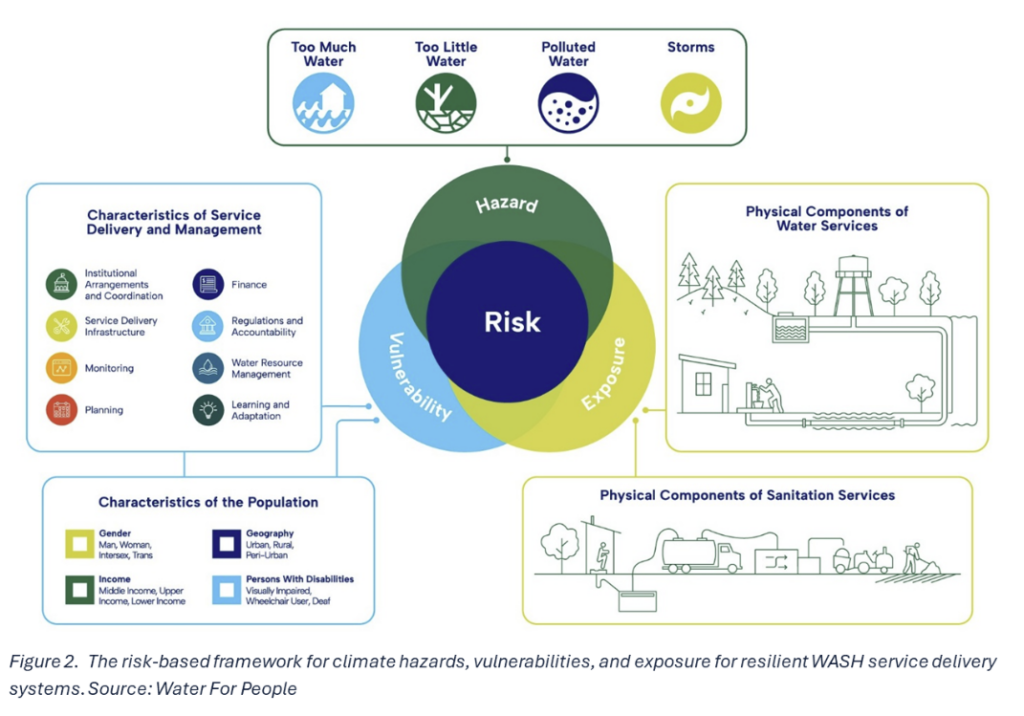
Water For People has been integrating climate resilience into sustainability thinking for over a decade, grounded in a risk-based framework shown in Figure 1 that considers three interacting elements: hazards (droughts, storms, floods, and pollution with greater intensity and unpredictability), exposures (the physical features that deliver WASH services), and vulnerabilities (characteristics of the population and the characteristics of the service delivery systems themselves). The combination of these three elements drives adaptation priorities. While we cannot change the hazards, we can reduce vulnerabilities and target those most disproportionately affected.
Adaptations across all four countries aligned to three overarching aims:
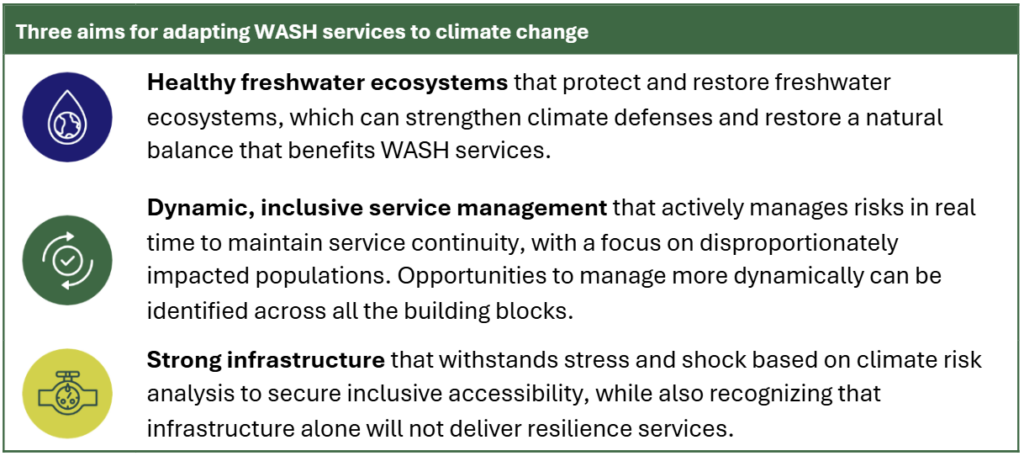
Notably, infrastructure adaptations were the least common of the three, accounting for only 18 of 80 documented actions, compared to 38 related to service management and 27 related to ecosystem health. This challenges the instinct to default to physical infrastructure when imagining climate impacts on water systems.
What Evidence Shows: Variation Is the Point
Across 80 adaptations, we identified 24 distinct adaptation types and even greater variation within each type. Only three appeared across all four geographies: capacity building on service sustainability and resilience, implementation of nature-based solutions, and climate risk and vulnerability assessments.
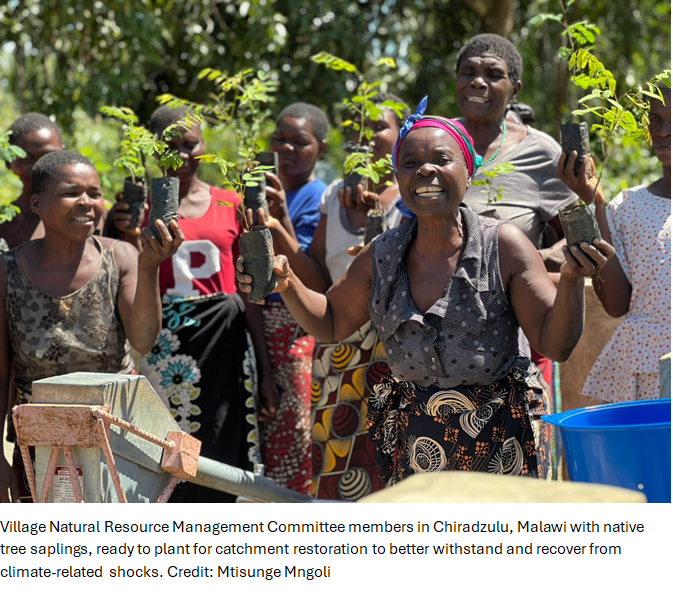
Even within those shared types, local adaptations varied significantly. Nature-based solutions ranged from land management to prevent gully erosion in Malawi, to mapping high-recharge areas for forest conservation in Guatemala, to establishing tree nurseries to stabilize catchment banks in Uganda, to planting trees in source-area micro-catchments in Peru. Same adaptation type, four different solutions, due to the unique combination of hazards, exposures, and vulnerabilities in each place.
Three others worth mentioning because of their priority in most geographies include:
- Monitoring service quality, sustainability, and resilience
- Policy development and compliance
- Technology alternatives and innovation
Other examples profiled in the case studies include renewable energy supplies, early warning systems, sanitation, waste recovery and re-use, monitoring of water resources, and establishing catchment investment programs where downstream water users pay for upstream protection.
The variation across contexts underscores that effective climate adaptation in WASH is fundamentally place-specific, and area-based risk assessment is the only reliable way to identify what needs to change and where.
Lessons Learned and the Road to Resilience Ahead
Local leadership and community cohesion are non-negotiable. Inclusive, participatory processes aligned with the principles of Locally Led Adaptation produce the most durable outcomes, but only where community cohesion and organization exist. Where communities are fractured or lack strong local leadership, technically optimal solutions may simply not be implementable. Strengthening social organization is itself a climate adaptation.
Two-way learning unlocks better solutions. Adaptations that seem novel to the WASH sector are often not new to community members. Ancestral practices — particularly around nature-based water management — frequently predate and inform what practitioners frame as innovation. Designing programs with a genuine intent to learn, not just transferring knowledge, consistently surfaces better solutions.
We still lack the measurement frameworks that resilience demands. Water For People has partnered with governments to measure WASH service quality and sustainability for over a decade, but robust indicators for resilience — especially at the district or regional scale — remain underdeveloped. Frameworks like "How Tough is WASH" have yielded important system-level insights, but a clear measurement approach that can inform climate priorities across an entire district is still needed. We are actively engaging with the WHO/UNICEF effort to identify climate-resilient WASH indicators that will inform future JMP and GLAAS global monitoring and will adapt our frameworks accordingly.
Resilience requires policy coherence across levels of government. National climate policies that incorporate WASH resilience and national WASH policies that include climate action create an enabling environment for progress. When national frameworks bridge global commitments and local needs, financial resources can flow toward the most impactful adaptations. Misalignment between policy levels remains one of the most significant structural barriers to scale.
Building resilience is a process, not a project. Many of the most impactful adaptations, particularly ecosystem-based interventions, produce results on timescales that exceed standard project cycles. For example, planting trees in a recharge area will not measurably increase dry-season water availability until those trees are established. This requires honest expectation-setting with funders, investment in intermediary indicators, and prioritizing partners with genuine long-term commitment.
Cross-sector integration is the next frontier. Water and sanitation services cannot be managed in isolation from the freshwater ecosystems that sustain them, or the agricultural, environmental, and health systems that intersect with them. Future programming, financing, and policy advocacy must reflect this — moving beyond WASH-siloed thinking toward strategies that engage living, dynamic systems shaped by climate variability.
Investment in the WASH sector should not begin with infrastructure, but rather with a strategic assessment of vulnerability and climate resilience.
Understanding environmental vulnerabilities allows local governments to prioritize and make more efficient and sustainable investments, thereby promoting water security in the WASH sector.
Conclusion
Together, the Guatemala, Malawi, Peru and Uganda Climate Resilient WASH case studies reveal both meaningful progress and the scale of the work still ahead. They highlight practical forms of resilience shaped by local leadership, cooperation, and iterative problem-solving, offering lessons that can inform more adaptive and durable water and sanitation systems in the face of climate change.